
Does Trump’s bold Crypto move make sense?
Making America the "Crypto Capital of the World."

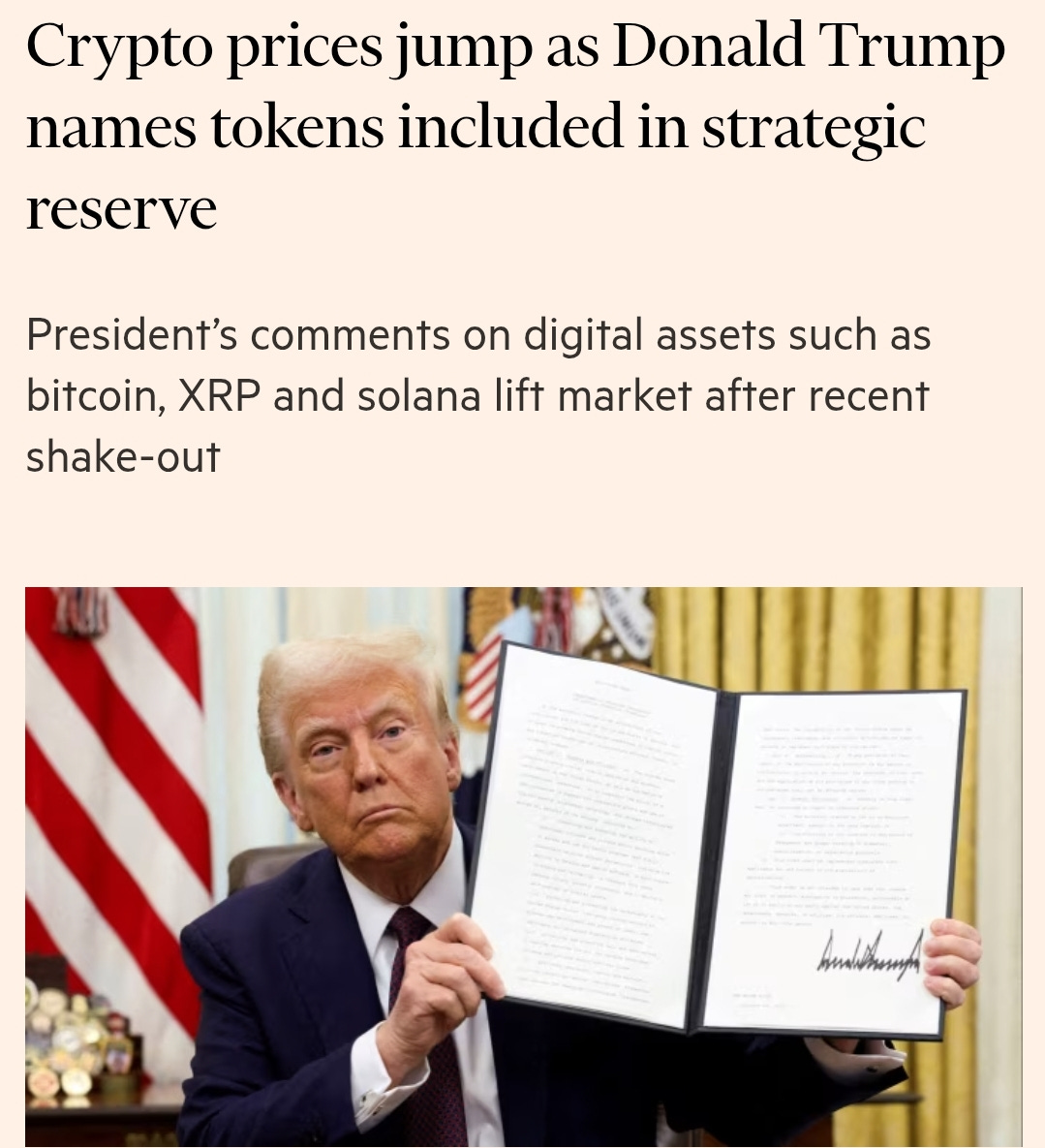
Cryptocurrencies are inherently speculative assets. As a researcher in this field, my role is not to promote or endorse them but rather to observe and analyze their market dynamics from an academic perspective. The image featured in the heading, sourced from the Financial Times on March 3, 2025, reflects a moment in this volatile landscape. Since then, Bitcoin, consistent with its historical pattern, has experienced substantial price fluctuations, including a significant decline.
What does all this mean? What are the broader implications of these developments? How might Trump’s adventurous actions influence the cryptocurrency sector? This week I am in Tokyo attending the GFTN 2025, and while this issue is the elephant 🐘 in many of the discussions among the industry experts in the field attending this event, majority seem to think or suggest that it may ultimately be an overblown concern—merely a "storm in a teacup." 🍵. However, the question remains: is this truly the case?
The following is my contribution summarised from many reports written by experts in the field1. See also my earlier article on another president’s adventure in this sector. Here goes.
U.S. President Donald Trump named Bitcoin (BTC), Ethereum (ETH), XRP, Solana (SOL) and Cardano (ADA) as five assets to be included in a U.S. strategic crypto reserve. The initial announcement excluded BTC and ETH, but added later, in classic Trump style, as he wrote “I also love Bitcoin and Ethereum!” on Truth Social.
Trump believes and I quote him that “A U.S. Crypto Reserve will elevate this critical industry… which is why my Executive Order on Digital Assets directed the Presidential Working Group to move forward on a Crypto Strategic Reserve that includes XRP, SOL, and ADA… which will make sure the U.S. is the Crypto Capital of the World”.
This development marks a significant milestone; however, the manner in which it was executed raises numerous critical questions. Justifiable scrutiny is expected, particularly regarding the selection process for the cryptocurrencies included in this Trumps’s new US reserve.
Bitcoin's inclusion is logical, and arguments could be made in favor of Ethereum (ETH) and possibly Solana (SOL). However, the decision to incorporate XRP and Cardano (ADA) is likely to be contested. There is a perceived element of "pay-to-play" in the selection process. Notably, Ripple has actively engaged in lobbying efforts within the United States, including a $5 million donation in XRP to the Trump Inauguration Fund, and its CEO is alleged to have dined with former President Trump. Similarly, the founder of Cardano has publicly expressed intentions to establish a division dedicated to lobbying and engaging with the incoming Republican administration.
Furthermore, the manner in which this initiative was publicly announced suggests a lack of strategic planning. The initial omission of BTC and ETH from the first statement by President Trump raises legitimate concerns. If the U.S. government were genuinely focused on building a strategic reserve, a more prudent approach would have been to accumulate these assets discreetly, thereby preventing market frontrunning. Additionally, any significant policy shift of this nature would likely require congressional approval, raising questions about whether a sitting president has the unilateral authority to make such a decision.
It is possible that the U.S. government intends only to retain the Bitcoin it already possesses—an estimated 200,000 BTC, primarily acquired through asset seizures related to the Silk Road and Bitfinex hacks. However, if the objective extends to acquiring XRP or ADA, the government would need to purchase these assets on the open market. There also remains an ongoing debate over whether the U.S. government is obliged to return approximately 95,000 BTC of its current holdings to Bitfinex, a factor that could significantly diminish the size of any proposed strategic reserve.
Another contentious aspect is the potential for insider trading linked to this announcement. The emergence of well-timed derivatives positions raises suspicions reminiscent of past incidents, such as the issuance of the Trump Coin, where certain actors appeared to have had prior knowledge and executed trades accordingly. Whether these concerns amount to mere speculation or concrete instances of market manipulation remains to be seen. However, a thorough investigation would require regulatory intervention—an outcome that may be influenced by the political affiliations of those involved.
The broader geopolitical implications of this move are also uncertain. China, for example, currently holds approximately 190,000 BTC as a result of seizures from the PlusToken Ponzi scheme. Meanwhile, smaller nations such as Bhutan, El Salvador, and the Czech Republic have already accumulated Bitcoin reserves or are in the process of doing so. Whether this initiative by the U.S. will prompt other nations to follow suit remains unclear.
A significant deterrent for many governments has historically been the stringent anti-Bitcoin stance of both the United States and U.S.-led financial institutions such as the International Monetary Fund (IMF), the World Bank, and SWIFT, on which smaller economies heavily rely.
While, on balance, this development is a positive signal for the cryptocurrency industry, concerns remain regarding the selection of specific assets and the broader implications of the policy’s execution. This moment represents a pivotal juncture not only for the crypto sector but also for the evolution of global finance and monetary policy.
Comments, feedback as always welcome. Stay tuned for my 5 minutes of fame on Somalia's education sector soon.
Privately acknowledged via emails and happy to share all references to those who are interested in this discussion. Henri Arsalian has influenced my thoughts on the future of money and I want thank him.