The header video clip for this week was recorded while I was in Indonesia, where I had travelled for a project centred on books and education outreach. I began filming it there because what I wanted to say felt inseparable from where I was standing: in a city where people had decided, deliberately, that books matter and that education is worth organising around. That decision, simple as it sounds, is the whole argument of this post.
This post, Week 17’s MI 5 Minutes of fame (delayed due to other commitments) returns to a theme I have visited before, see here on this Substack and in other fora1 and one I will keep returning to in future episodes: books, libraries, and what they mean for Somalis both at home and in the diaspora. The subject keeps pulling me back, partly because it is personal, and partly because I think it carries more civic weight than it is usually given credit for.
What a Library Actually Does
There is something quietly powerful about a library. Not just the books on the shelves, but what their presence says: that a community is worth knowing, that its stories deserve a permanent home, that someone thought it important enough to make room.
And yet, in my experience across Australia, Somali communities remain significantly under-connected to this resource and to the broader civic life that surrounds it. That is something I am actively working to change. I am currently developing a project to engage libraries in Melbourne’s inner and northern suburbs2, where large numbers of Somalis live, to explore how those institutions can better reach and be reached by the Somali community.
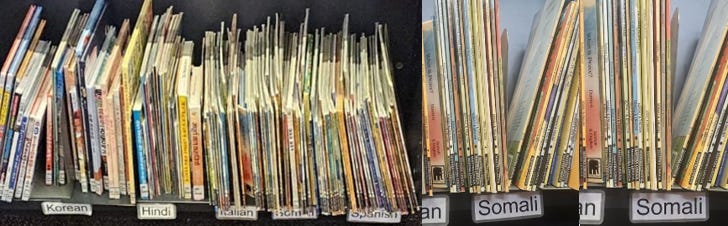
The City of Melbourne’s Kathleen Syme Library and Community Centre in Carlton is already doing something worth noting. It holds a small but meaningful collection of Somali books3. That kind of gesture matters. It says you are here, and we see you.
I have covered this territory before and I will come back to it properly in future posts, including how the proceeds from two new books on Somalia will support students back home. But what follows picks up where those earlier conversations left off.
What happened to libraries in Somalia?
Growing up in Mogadishu, I was lucky. The city had libraries, real ones, with shelves you could browse, books you could hold, and bookshops where you could spend an afternoon losing yourself in another world. As a young Somali student, that access felt ordinary at the time. It was only later, after everything changed, that I understood how precious it was.
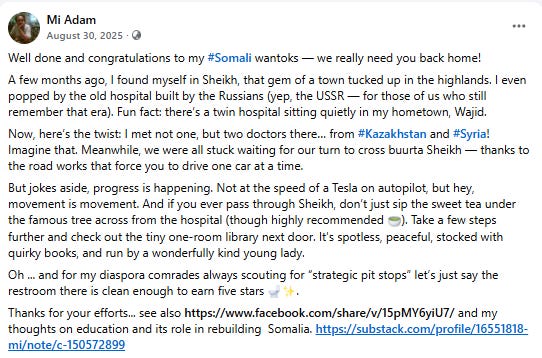
On a recent trip home, I was surprised and moved to find a one-room library in Sheikh. Someone had decided that books matter enough to make a space for them, even in modest circumstances. Hargeisa used to have a one-room library too, and it left an impression on me each time I passed it. On my most recent visit, it was no longer there. That absence sat with me.
Two Books and an Empty Date-Due Slip
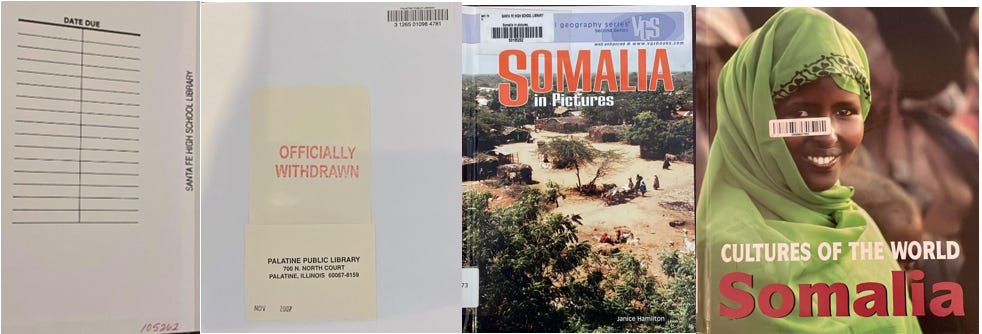
My daughter gave me some books she found at a local market in the US, the kind where people spread their belongings on folding tables and sell stuff for a dollar or two. Among the odds and ends, she found them: two books about Somalia. One called “Somalia in Pictures,” part of a Visual Geography Series, authored by Janice Hamilton. The other, “Cultures of the World: Somalia.” Both had clearly come from public libraries, officially withdrawn, deaccessioned, given away because they were no longer wanted.
I stood there holding them, feeling something, I could not quite name.
One of the books had a date-due slip in the back, the old kind, with rows for stamps recording each time a borrower took it home. Every single row was blank. In all the years that book sat on a shelf at the Santa Fe High School Library, not one person checked it out. Not once. I am not sure what I expected. But seeing that empty slip, knowing that a book about my country, my people, my home, sat untouched for years before being quietly discarded, was a particular kind of sadness.
It made me think again about Mogadishu and other parts of Somalia, Hargeisa, Sheikh among others. About the libraries I used to visit. About the bookshops on streets I can still picture but can no longer walk. I find myself asking a question I do not have a good answer to: what happened to all those libraries and bookshops? The war consumed so much, buildings, records, institutions, entire neighborhoods. But books are also vulnerable in quieter ways, through neglect, displacement, and the slow erosion of institutions that once held them.
For Somalis in the diaspora, this loss is doubled. We left a place where books about us existed, in our own language, on our own shelves, in our own hands. And we arrived in countries where in some cases, books about Somalia gather dust until they are sold off for a quarter at a Sunday market.
Why Books Are the Shortcut
I want to say this directly, because I think it often gets buried in more comfortable language.
Nations rebuild through institutions, and institutions are built by educated people, and educated people begin, almost always, with books. Not exclusively, not in isolation, but as a foundation. A child who grows up with access to a library grows up with something harder to name but impossible to overstate: the sense that knowledge is available, that questions are worth asking, that the world beyond their immediate circumstances is real and reachable.
For Somalia, a country still in the middle of rebuilding its institutions, its governance, its economy, and its place in the world, this is not a luxury. It is infrastructure. A generation that reads widely, thinks carefully, and engages with ideas across disciplines will do more for Somalia’s future than any single policy intervention I can name.
And for Somalis in the diaspora, the stakes are just as real. Civic participation, economic mobility, and the capacity to contribute meaningfully to both your adopted country and your country of origin all begin with engagement with knowledge. Libraries are where that engagement can start, for free, today, without a visa or a qualification or permission from anyone.
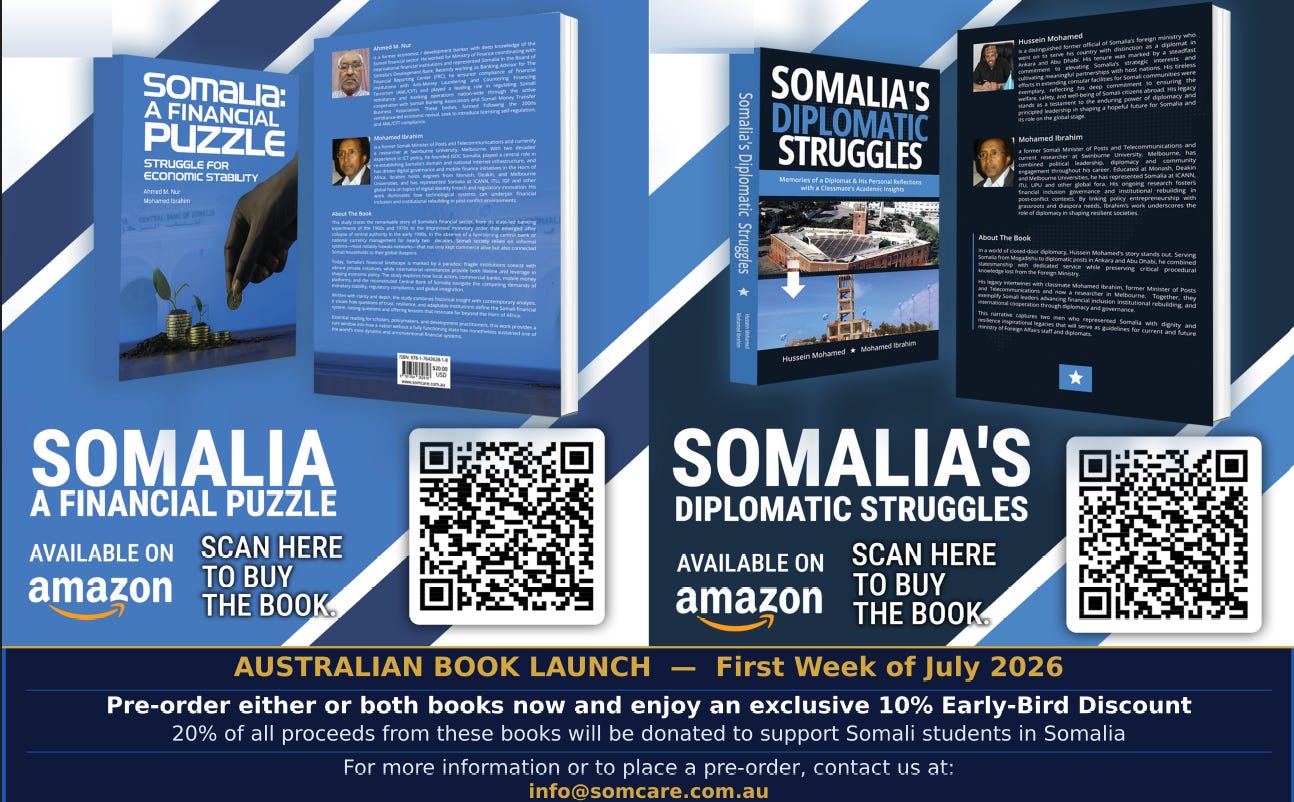
A Note on Two Books - The Indonesia trip was also part of preparations for the Australian launch, in the first week of July 2026, of two books published in Solo that I believe deserve your attention.
“Somalia: A Financial Puzzle, Struggle for Economic Stability,” co-authored by Ahmed M. Nur and Mohamed Ibrahim, and “Somalia’s Diplomatic Struggles,” by Hussein Mohamed and Mohamed Ibrahim, together cover the terrain this Substack has been navigating for years: monetary fragility, institutional failure, diplomacy, and what it actually takes to rebuild a state. Both are available now for pre-order via info@somcare.com.au, with a 10 percent early-bird discount, and 20 percent of all proceeds will go directly to supporting Somali students in Somalia. How that donation stream will be structured, governed, and tracked is something I will address properly in a future episode. It matters, and it deserves more than a footnote.
A Call to Act
Someone has to care about this. I think it should be us. If you are a Somali in the diaspora, find your local library and use it. If you have children, bring them. If you are in a position to donate books about Somalia or by Somali authors, consider doing so. If you are in Somalia, support the small libraries that remain, and advocate for more. If you are an institution or an organisation with the capacity to build collections or fund libraries, the need is real and the impact is traceable.
Books are not a soft intervention. They are, in my view, the most durable investment a community can make in itself. And for a nation with Somalia’s history and Somalia’s potential, they may well be the shortest road forward.
Comments and feedback, as always, welcome.
A note from my trip home in another forum…